Productivity Dashboard Guide for 2026 | Build a Clearer Focus System
2 mins read

Modern productivity systems are becoming increasingly noisy.
Most people today do not struggle because they lack ambition. They struggle because their attention is constantly fragmented across notifications, disconnected tasks, multiple apps, unfinished ideas, and endless mental tabs.
A productivity dashboard is no longer just a place to store tasks. In 2026, it has become a cognitive clarity system.
The best productivity dashboards do not simply organize work. They reduce overwhelm, create execution visibility, protect attention, and help users reconnect daily actions with meaningful direction.
This shift is important because many traditional productivity tools accidentally increase mental load instead of reducing it.
More dashboards.
More widgets.
More categories.
More metrics.
More notifications.
But better productivity rarely comes from more information.
It comes from clearer execution.
What Is a Productivity Dashboard?
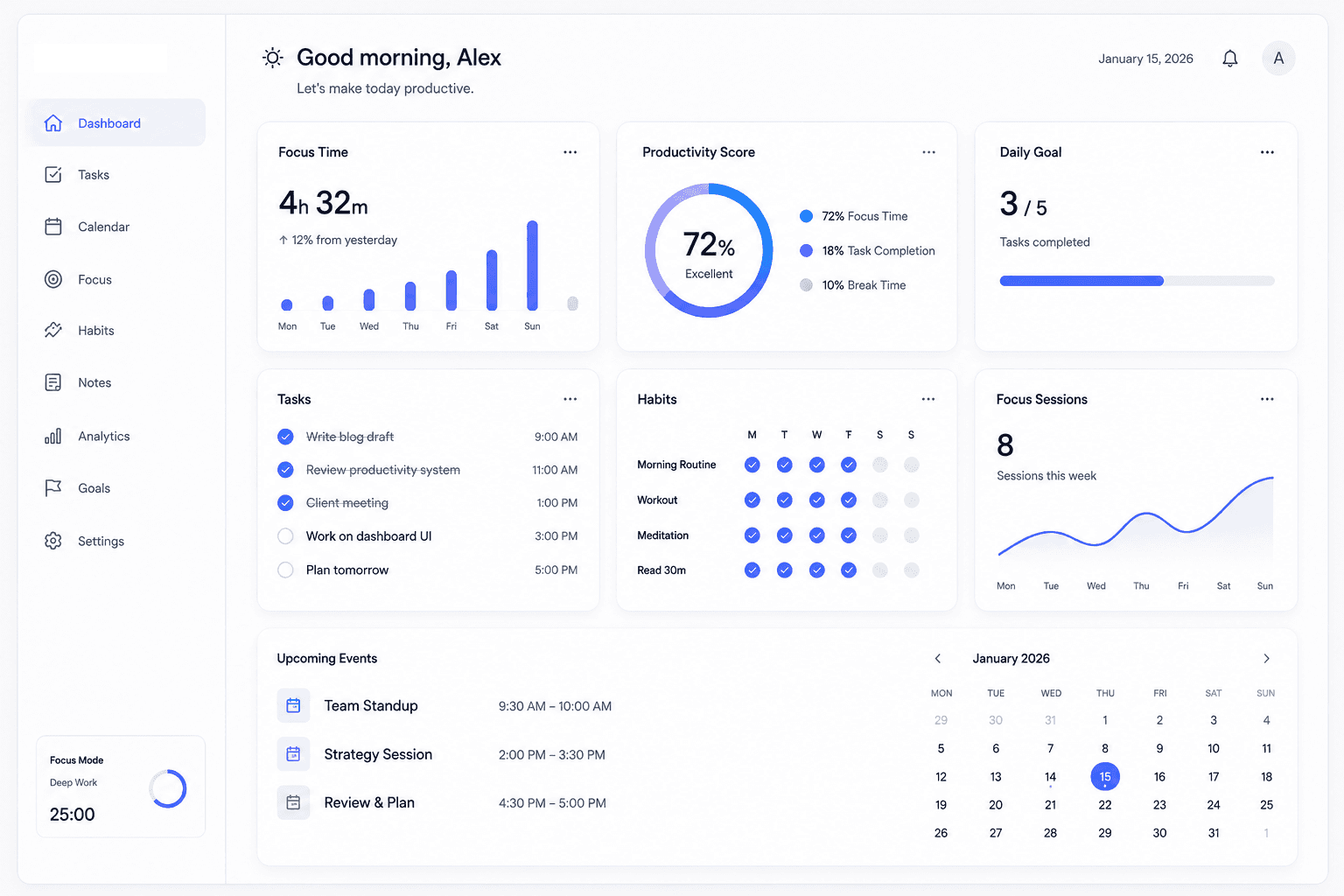
A productivity dashboard is a centralized workspace designed to help users:
track goals
manage tasks
organize priorities
monitor progress
reduce cognitive overload
maintain focus visibility
improve consistency
However, modern productivity dashboards are evolving beyond traditional task management.
The best systems in 2026 combine:
behavioral psychology
attention management
visual clarity
emotional sustainability
focus architecture
execution systems
Instead of functioning like digital storage systems, modern dashboards are becoming execution environments.
Why Traditional Productivity Systems Often Fail
Many productivity dashboards become overwhelming because they prioritize information density instead of mental clarity.
Users often begin with excitement:
color-coded boards
advanced tagging systems
multiple databases
complex routines
layered planning systems
But after several weeks, the dashboard itself becomes emotionally exhausting.
This happens because the brain experiences cognitive resistance when systems become heavier than the actual work.
Some common productivity dashboard problems include:
Excessive Planning
Many systems encourage endless organization without meaningful execution.
Users spend more time arranging workflows than completing meaningful tasks.
Hidden Priorities
Important goals disappear beneath urgent tasks, notifications, and daily maintenance work.
Cognitive Fragmentation
Switching between apps, tabs, projects, and categories increases mental switching costs.
Motivation Dependency
Some dashboards only work when users feel highly motivated.
Sustainable systems should still function during low-energy periods.
Emotional Overload
Large unfinished lists create guilt, anxiety, and avoidance.
This is especially common among users managing ADHD, burnout, or executive overload.
The Psychology Behind Productivity Dashboards
A productivity dashboard influences much more than organization.
It affects:
emotional state
cognitive clarity
motivation perception
behavioral consistency
decision fatigue
focus endurance
The design of a dashboard changes how users think.
This is why modern productivity systems increasingly focus on behavioral architecture rather than simple task management.
Cognitive Overload and Attention Fragmentation
The human brain performs poorly under constant context switching.
Every interruption creates cognitive residue.
This means part of the brain remains attached to the previous task even after switching to a new one.
As a result:
focus weakens
clarity drops
mental fatigue increases
execution slows down
A well-designed productivity dashboard reduces these switching costs.
Instead of displaying everything simultaneously, modern dashboards should surface:
the current mission
next meaningful action
focus priorities
energy-aware tasks
progress visibility
The goal is not maximum information.
The goal is maximum execution clarity.
What Makes a Great Productivity Dashboard in 2026?
The best productivity dashboards in 2026 are built around human behavior.
Not just organization.
1. Mission Visibility
Users should always understand:
what matters most
why it matters
what the next step is
Long-term goals should remain visible instead of disappearing into hidden menus.
2. Reduced Mental Friction
Good dashboards reduce the emotional cost of starting work.
This includes:
simplified interfaces
low-clutter design
visible next actions
minimal cognitive resistance
3. Sustainable Focus Systems
Modern dashboards should support:
deep work
attention protection
recovery cycles
realistic productivity
4. Emotional Sustainability
Productivity systems should not create shame.
The best systems support restarting after inconsistency instead of punishing users for missing days.
5. Cross-Life Organization
People no longer separate life into isolated productivity categories.
Modern dashboards increasingly combine:
work
health
habits
relationships
goals
learning
personal growth
inside unified systems.
Productivity Dashboard vs Traditional Task Managers
Traditional Task Manager | Modern Productivity Dashboard |
|---|---|
Stores tasks | Supports execution |
Focuses on lists | Focuses on clarity |
Encourages organization | Encourages meaningful action |
Often reactive | More intentional |
Tracks tasks | Tracks momentum |
Measures activity | Measures progress |
This difference is important.
A productivity dashboard should feel like an operating system for focus and execution.
Not just a digital checklist.
The Rise of Minimal Productivity Dashboards
Many users are moving away from overly complex systems.
Minimal productivity dashboards are becoming increasingly popular because they:
reduce visual noise
improve focus
simplify decisions
lower overwhelm
improve consistency
Minimal does not mean simplistic.
It means intentional.
The best minimal dashboards still provide:
goal visibility
progress tracking
structured planning
execution systems
focus protection
without creating mental clutter.
Productivity Dashboards and ADHD-Friendly Design
Modern productivity dashboards increasingly consider neurodiversity.
This is important because many users struggle with:
executive dysfunction
time blindness
task paralysis
emotional overwhelm
working memory overload
ADHD-friendly dashboards often include:
visual priorities
reduced complexity
visible goals
shorter action steps
quick capture systems
low-shame productivity flows
Systems designed around behavioral realism tend to create stronger long-term consistency.
Focus Visibility Matters More Than Motivation
One of the biggest productivity myths is that successful execution depends primarily on motivation.
In reality, clarity often matters more.
When users clearly understand:
what to do
why it matters
where to begin
mental resistance decreases.
This is why modern productivity dashboards prioritize:
visible priorities
structured focus
execution simplicity
mission alignment
instead of endless motivational content.
Building a Productivity Dashboard That Actually Works
A sustainable dashboard should feel calm.
Not overwhelming.
Here are the most important layers.
Goal Layer
This contains:
long-term direction
missions
personal growth goals
focus areas
Goals should remain emotionally visible.
Hidden goals quickly lose momentum.
Execution Layer
This contains:
actionable steps
task sequencing
daily execution
recurring systems
The focus should remain on meaningful progress.
Not endless task accumulation.
Reflection Layer
Modern productivity systems increasingly include:
journaling
reviews
emotional reflection
progress awareness
behavioral analysis
Reflection improves:
self-awareness
learning
consistency
long-term adjustment
Focus Layer
Attention protection is now a major productivity priority.
Dashboards should support:
deep work
reduced distractions
focus blocks
attention recovery
cognitive pacing
Why Aesthetic Design Impacts Productivity
Visual environments affect emotional state.
Cluttered dashboards increase cognitive stress.
Calmer interfaces improve:
focus endurance
perceived control
mental clarity
willingness to engage
This explains why modern productivity apps increasingly use:
softer visuals
dark focus themes
reduced clutter
intentional spacing
calmer UI systems
Design is not just visual.
It shapes behavior.
Productivity in 2026 Is Becoming More Human
The productivity industry is changing.
Users are becoming increasingly aware that:
burnout is not success
constant urgency is unsustainable
excessive optimization creates exhaustion
attention is limited
emotional sustainability matters
As a result, modern productivity systems increasingly focus on:
clarity
focus
recovery
sustainable consistency
emotional realism
This shift is reshaping how productivity dashboards are designed.
The Future of Productivity Dashboards
The next generation of dashboards will likely focus more on:
behavioral intelligence
focus protection
emotional awareness
attention architecture
adaptive systems
energy-aware planning
cross-life organization
The strongest systems will not simply help users do more.
They will help users work with greater clarity and lower cognitive resistance.
Final Thoughts
A productivity dashboard should not feel like another source of pressure.
It should feel like a calmer operating system for execution.
The best dashboards in 2026 are no longer built only around task management.
They are built around:
focus visibility
cognitive clarity
emotional sustainability
meaningful goals
realistic consistency
Because productivity is not simply about doing more tasks.
It is about directing attention toward what matters most.
And in a world increasingly designed to fragment focus, that clarity becomes incredibly valuable.
FAQ
What is a productivity dashboard?
A productivity dashboard is a centralized system used to organize goals, tasks, priorities, habits, and progress. Modern productivity dashboards increasingly focus on cognitive clarity and sustainable execution rather than simple task storage.
What should a productivity dashboard include?
A strong productivity dashboard should include goal visibility, actionable tasks, progress tracking, focus systems, and reflection tools without overwhelming the user with excessive complexity.
Are productivity dashboards good for ADHD?
Yes. ADHD-friendly productivity dashboards can reduce mental overload by simplifying execution, improving visual clarity, and reducing cognitive friction.
What is the difference between a productivity dashboard and a task manager?
Task managers primarily store tasks. Productivity dashboards are broader systems designed to support focus, planning, execution, and long-term consistency.
Why do many productivity systems fail?
Many systems fail because they become overly complex, emotionally exhausting, or dependent on high motivation. Sustainable systems reduce friction and support realistic human behavior.
Related
Productivity System:
https://articles.teloralife.com/productivity-system/